
Book Review: Sacred Rage by Steven Heighton
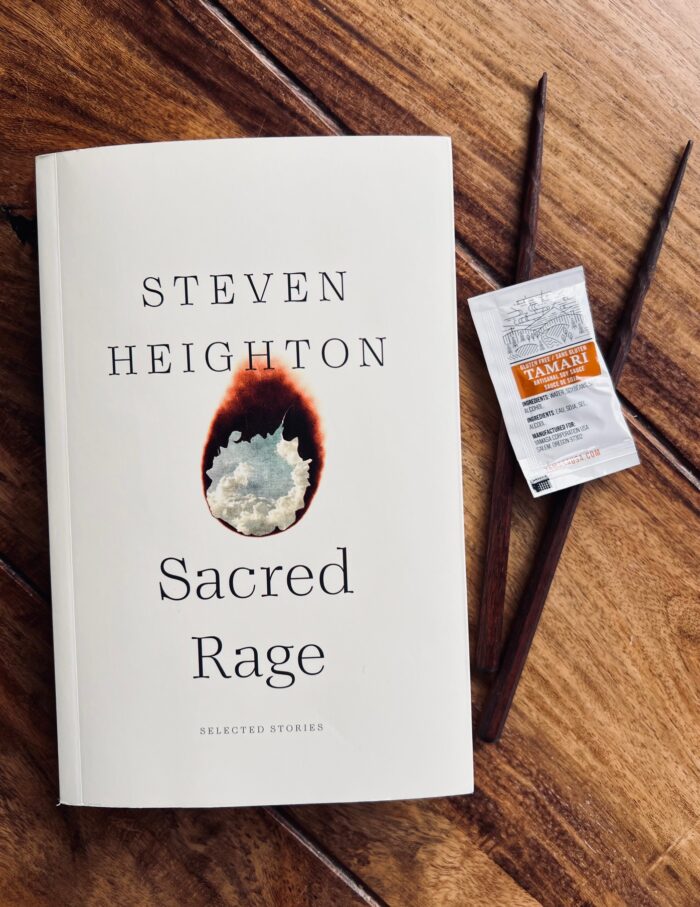
I have very fond memories of the poet and writer Steven Heighton, who sadly passed away in 2022 at the age of 60. I don’t often say I have fond memories of writers, as my time organizing their schedules and whereabouts was extremely stressful when in my role at Wordfest. However, Heighton was one of those rare gems who I only recall with affection. He was kind, quiet, and dare I say, protective of me. I recall one time struggling to convince a writer that they needed to stop drinking and go to bed so they could attend their reading on time the next day – Heighton stepped in and ensured the message was received. As a taller man, he could be quite intimidating, but those who knew him personally knew how kind and gentle he truly was. It is with these sentimental memories in mind that I decided to pick up the posthumously released short story collection Sacred Rage, which are selections from his previous books.
Book Summary
Made up of 15 stories taken across 4 separate collections, Sacred Rage is a selection that spans the breadth of Heighton’s career, with an emphasis on his writing that takes place in Japan. It begins with a lengthy introduction written by one of Heighton’s editors, John Metcalf. He quotes various stages of Heighton’s writing, adding his own interpretation and interspersing his personal memories of his friend. It’s heavy on the writing analysis and light on the personal anecdotes, written like a true editor. Next up is a series of stories that take place in Japan, typically from the perspective of a young Canadian man teaching English to kids for a living. After a handful of those, the collection takes a surprising turn, incorporating a wide range of stories and perspectives that continually surprised me. “Townsmen of a Stiller Town” details a fried chicken delivery that takes an extremely dark turn. “Nearing the Sea, Superior” describes a short moment in time while a couple breaks up in an airport on their way to see relatives. One of my favourites is “Professions of Love”; an interior monologue of a plastic surgeon, confessing his reasons for working on his wife without her consent. “Noughts and Crosses” is another example of a one-sided perspective while the narrator details their planned and unset response to an email from a previous lover. The stories vary in length; most are at least a few pages, while a few others quite a bit longer.
My Thoughts
I found the stories set in Japan to be a bit tedious, simply because they all felt a bit similar to me; each basically boil down to a single Western man who struggles to connect with Japanese citizens around him, while ruminating on the differences. None of them felt particularly unique, and while many people can relate to those feelings when they travel, it’s not necessarily provocative enough to justify so many retellings. But knowing that Heighton had written much more with a wide range of topics, I pushed through and was happily rewarded with the stories I mention above, with very thoughtful characters, plots, and meanings. Many of his characters feel as though they are talking directly to the reader, when in reality, they are justifying actions to themselves. This was an effective way of including me as a reader, and enveloping me in the drama. Sometimes I sympathized with them (the jilted lover for example) while others I disdained (think, the scalp-happy surgeon).
I think of Heighton as a true artist in every sense of the word, and one of my favourite quotes from this book is in the introduction, taken from his essay titled “The Age of Clowns” in which he writes:
“Perhaps the best that individual artists can do is to try to foster Ages of Integration in their own hearts. An integrated writer may not have the power to overthrow the centralized rule of the cynical and the grasping, but the power to move a few thousand people deeply is something, is much; in a world so fragmented, any gesture that radically connects mind to mind and heart to heart is hugely significant” (p. 9 of Sacred Rage by Steven Heighton).
I loved this idea, because Heighton admits that even though most will not become huge stars (he flew somewhat under the radar as a writer in Canada), simply moving your small and dedicated followers is enough, especially these days. Art brings us together, whether we realize it or not. Based on Metcalf’s introduction, I’ll assume that these stories were chosen to not only demonstrate the breadth of work that Heighton produced, but his friend’s favourites as well. It’s a fitting tribute to a writer lost too soon.