

Book Review: Venetian Vespers by John Banville
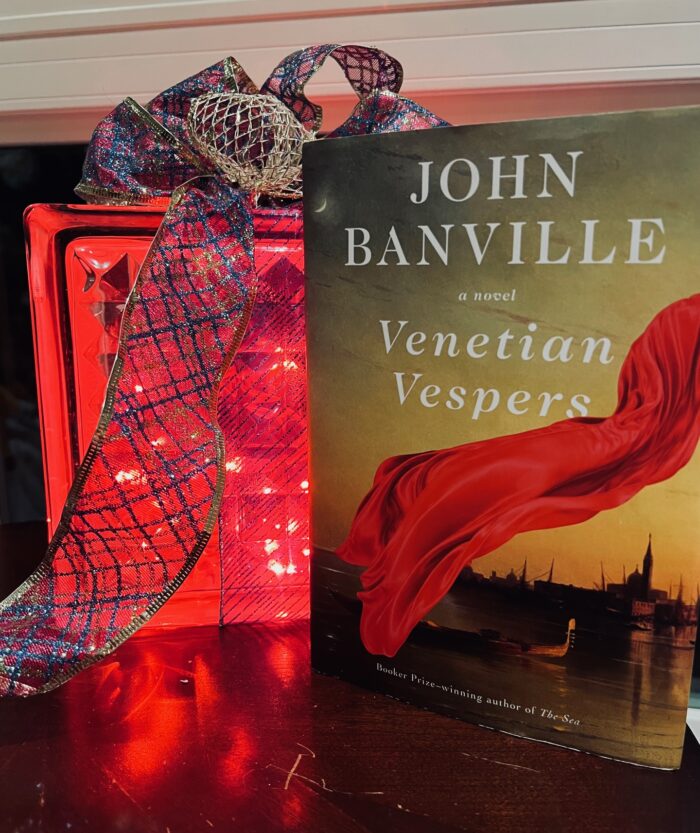
Thanks to a positive review from fellow book blogger FictionFan, I tracked down a copy of Venetian Vespers by John Banville as I knew I would likely enjoy it – and we were both right! The atmosphere, the uncertainty, the mystery at its heart – it was all brilliantly done. I’ve never read a John Banville book before, but apparently he’s won the Man Booker Prize, among many others, so I’m sure his name will be familiar to many. This may have been my first foray into this author’s work, but it certainly won’t be my last as he has many other books to enjoy in his bibliography.
Plot Summary
It’s 1899 and Evelyn and his brand new wife Laura are on a honeymoon in Venice. Evelyn is a writer who thinks very highly of himself, but only has a few travel guides to his name. His new wife Laura comes from an extremely wealthy family, but shortly after their marriage, her father dies, and they both discover that Laura has been cut out of the will, left with very little money. Laura doesn’t seem too surprised by this, and although Evelyn has already begun resenting her only months into their relationship, he contents himself with the idea that he has now married into even a little bit of money, elevating him from the lowly apartments he once inhabited. Their first night in Venice, Evelyn leaves Laura in bed to explore the city, and runs into a man who claims they were friends in high school, although Evelyn doesn’t remember him. They get drunk, and Evelyn makes his way back home, discovering Laura gone. Now, it’s Evelyn’s turn to not be surprised, and he figures Laura just found somewhere else to sleep in the giant crumbling palazzo they are renting. If anything, Evelyn is a bit relieved, because he’s found himself falling in love with another woman, the sister of the man he met the night before at the bar, and now he can spend more time pursuing her, without worrying about Laura, whom he figures is still meandering about the city somewhere. As the days pass and Laura remains missing, Evelyn seems to fall into a state of feverish madness. He has an odd cut on his finger that won’t heal, and the days begin blending into nights as he falls ill. The servants of the home also begin to act strangely, and finally, he’s approached by the police about Laura’s disappearance. He claims he doesn’t know anything about it, but he doesn’t seem the most trustworthy either – not to others, or the reader.
My Thoughts
I’ve never been to Venice and the closest I’ve ever come to it is seeing images of it in the movies, but after reading this book, my desire to go has (strangely) increased! And I say strangely because the city is described as an eerie, haunted place by the author. Even though Laura and Evelyn are coming from dark and foggy London, Banville’s Venice is described in much the same way: elusive, crumbling, dangerous, and full of criminals. This is partly due to the fact that the couple is visiting in the winter, which from what I gather is not the ideal time to go, but both the canals and the ancient buildings seem to hold deep and dark secrets perfect for suspicious characters to hide within. For a mystery lover like myself, this is the ideal place to set a psychological thriller as it ramps up the suspense and atmosphere.
The question of whether we can believe Evelyn as a narrator also ramps up the tension. From almost the first few paragraphs the reader is subjected to his selfish, deluded thoughts, so it’s obvious he’s not only a jerk, but sees the world through a distorted lens of his own. But just how distorted? There are many monologues like the one below that constantly throws his reliability into question:
“Or was I going mad? Had I gone mad? No. A crossing had been made, that was all, a moving over into some new place I had always yearned for, even if unknowingly. I was no longer myself; the self I had been before was gone now, gone forever ” (p. 108-109, Venetian Vespers by John Banville).
As for Laura’s disappearance, I had my theories as the plot continued, but I was wholly surprised by the ultimate reveal, so I was delighted to be wrong in the end. If I can guess the actual culprit or solve the mystery on my own I’m always a bit disappointed, so Banville’s characterization was strong enough to lead me in all sorts of directions, all of them incorrect. This confusion is something I think mystery lovers will agree is a sign of a book well written.
Phew, I’m delighted – and relieved! – that you enjoyed it! Ha, it’s a deliciously sinister picture of Venice, isn’t it? I bet their tourist board won’t be hiring him! Evelyn is so horrible, and yet so entertaining – he does these twisted narrators so well.
You were so right! Such an awesome recommendation FF, I’m going to talk about it on the radio next week as part of my best of 2025 segment :)
I read The Sea by Banville this summer and didn’t like it. One major thing I disliked was the main character and I couldn’t tell if I was supposed to empathize with him or not. This sounds more like we’re not expected to like Evelyn, which makes me wonder if I’d get on better with this one.
We are definitely not expected to like Evelyn – can confirm! hahaha
review-venetian-vespers-by-john-banville/
I will say that Fiction Fan and I disagree on some things when it comes to books, but she’s killer at picking mysteries with an awesome ambiance and characters. Remember when she got everyone to read that novella several years ago? What was it called? I’m blanking…. (goes to the search bar on my own website…). The Lodger! By Marie Bellac Lowndes. Even my mom read it! I’ll see if my library has this new recommendation.
Yes it was definitely the Lodger! But totally agree, she’s really good at picking mysteries, I think it’s something she specializes in hahah
I’ve read Banville’s Book of Evidence trilogy recently, and loved it, his writing style is so, well, mysterious! This sounds more thriller-y, which isn’t always my fav genre, but if anyone can do it well, Banville can… I’m sold!
I was really impressed by this one, so I’ll definitely be checking more of his stuff out. Here I was thinking he was a hidden gem, but turns out I was just out of the loop haha
Well, since both you and FF loved it, then I will add it to my TBR!
You won’t be disappointed Laila! And Happy New Year to you :)
I can’t remember if you also enjoy watching crime stories, but Quirke (also based on a JB series) is quite good (and sometimes on CBC Gem, for some weird reason).
I would watch crime shows if I had the time. I had started watching Only Murders in the Buildling (which granted, is more comedy too) but again, I watch like one episode every two months, so I’m not the best at this. Put this under the heading of ‘when I have more time’ LOL