
Book Review: The School of Night by Karl Ove Knausgaard
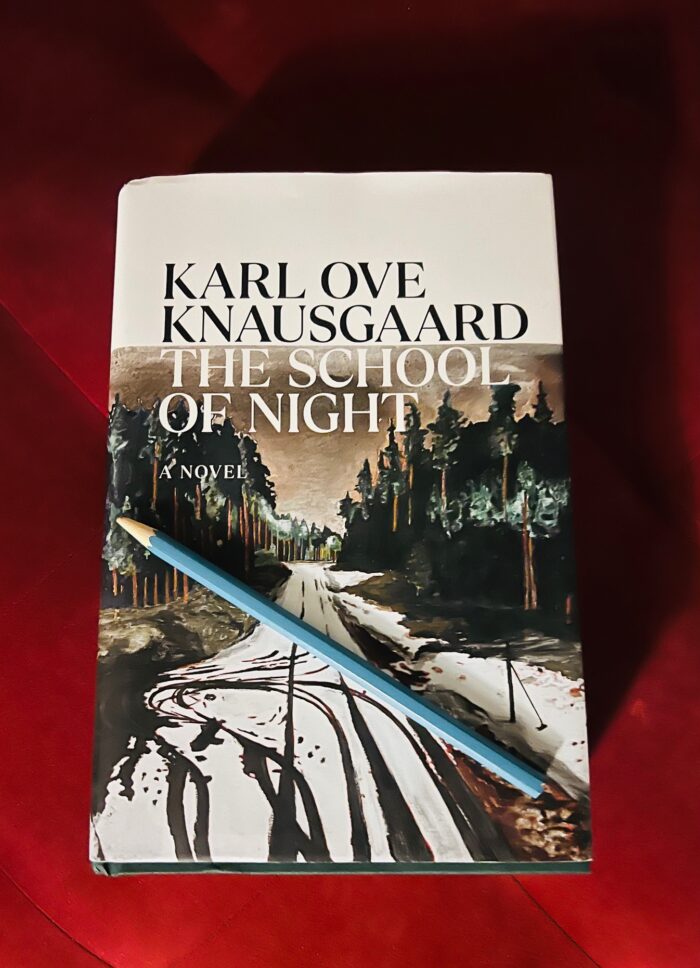
When I received a copy of Karl Ove Knausgaard’s latest book The School of Night, I knew it would be a challenging read. My first clue? The fact that it was 500 pages, and heavy as a brick. My second clue was when I mentioned him to other readers – many would react with a quizzical look, and then a question – isn’t he quite dark? This was my first time reading him, and his reputation of being a serious writer is solidified in this novel; long, drawn out pages without a single break of text, rambling soliloquies on the importance of art, and very little dialogue or plot points. It wasn’t easy to get through, although I’m glad I did. I don’t mind settling into the darkness for awhile, as long as I know I can come out of it.
Plot Summary
Kristian has just moved to London, eager to succeed in art school and gain recognition for his photographs. But when his classmates and family react with nonchalance, even criticism, he quickly decides that they aren’t worth his time, and sets about pushing himself and his artistic limits regardless of their lackluster responses. An odd man named Hugh approaches Kristian in a bar, and they strike up an unlikely acquaintance. Kristian is reluctant to engage with him, but can’t help following Hugh home, as he seems to be his only friend in the city. Through Hugh, Kristian becomes romantically involved with Vivian, a theatre director who both repels and attracts him, but again, with seemingly no one else to turn to, he begrudgingly accepts her attention when it’s convenient for him. On his way to her apartment one night, Kristen’s offer to light someone else’s cigarette pivots the direction of his future. The book than skips ahead twenty years to Kristian’s life in his forties; he is a famous photographer, married with one son. He appears to have all he ever wanted, yet his life remains empty, and he chooses to fill the void with selfish interactions and relationships with others, taking whatever he wants when it suits him, and abandoning people just as quickly.
My Thoughts
It’s always a bit strange when an author chooses to write a book from the perspective of a very unlikeable character. What are we to do with Kristian, other than dislike him? Of course, the symbolism of his name is less than subtle, as is his actions. At times, he admits to himself that he could have handled things differently, but he is so deeply rooted in his own narcissism that he manages to excuse it all away, often seeing himself as the victim, even as he hurts others. It’s no spoiler to reveal that negative things befall Kristian, the promotional material references Doctor Faustus, and most people who are willing to pick up a 500 page book in the first place will likely be familiar with that play anyway. But despite knowing the dark end that awaits Kristian, I couldn’t help but wonder at his selfish actions and naiveté. There are certain interactions that he has with his family that are hard to believe because he is so cold, and yet these are all taking place in the mid 1980s, so we don’t even have social media to blame for them! He’s just a jerk.
Kristian’s actions are selfish, but his inner thoughts are just as bad. He often thinks about death, and the smallness of his life, but instead of this galvanizing him into any kind of action, he just judges those around him, smug in the fact that he believes himself better than them:
“I folded the newspaper, put it in my bag and grabbed a seat in the packed carriage of the train. In a hundred years, everyone in it would be dead and a whole new set of people would occupy their places. And still they thought themselves important and unique, as if whatever they did, thought and said was significant. Well it wasn’t. The thought of this made me smarter than them, but no happier” (p. 123 of The School of Night by Karl Ove Knausgaard).
Because we know from the outset that Kristian is an awful person and deserves whatever befalls him, I found myself growing impatient with the slow pacing. His musings on art, life and death were annoying to begin with, but as I became even more fed up with him, I was even more inclined to tune out his ramblings. Which leads me back to my first question – why choose Kristian as the narrator, even as we hate him? Perhaps it shows how truly evil is he, knowing his inner demons are just as bad as his outer actions, but it does make for a less pleasant reading experience.

Hmm, I don’t think I could put up with Kristian for 50 pages much less 500! Congratulations on making it through!
It was no easy feat! haha
I’m curious if the novel is in first-person point of view of this annoying man, or if the narrator is third-person POV view, and that narrator has some insight into this giant doofus. I couldn’t have stuck with this for 500 pages. I do remember that you stuck with that one ginormous book that was, I think, one sentence? Duck something? Newduck…something? Duckport?
Yes, I do tend to ‘stick it out’ with books that I don’t love because in most cases the publisher has sent it to me in exchange for an honest review, so I feel duty bound to finish it haha
This was first person point of view! I would have liked hearing other people’s points of view I think
Well, I feel content to skip this one, so thank you for that!
You’re welcome! haha
I just finished a much shorter novel with a very unlikeable main character, but at least she was interesting! I can hang with unlikeable if you’re not boring! Kudos to you for finishing this one.
I would have maybe even enjoyed this book if it was way shorter! haha
Is it strange to write unlikeable characters, really? I think most of us are unlikeable at least some of the time, at least to some people. At least on a “bad day”. Surely the world isn’t so simple as nice and thoughtful people and mean and thoughtless people?
Having said that, I’ve seen him at festival a couple times, and I’ve collected a couple of his books (but out of order, unfortunately), but never feel like I’m in quite the right mood for that style when I am simultaneously in the mood for a long book (I think alllll his books are long, most anyway).
Yes I’ve heard his books tend to be very similar to this. Long, dark, self absorbed, etc. And you are right that it isn’t strange to write unlikeable characters, but for us to have to live with this man for 500 pages and not hear from others? It was painful haha