
Book Review: Meditations for Mortals by Oliver Burkeman
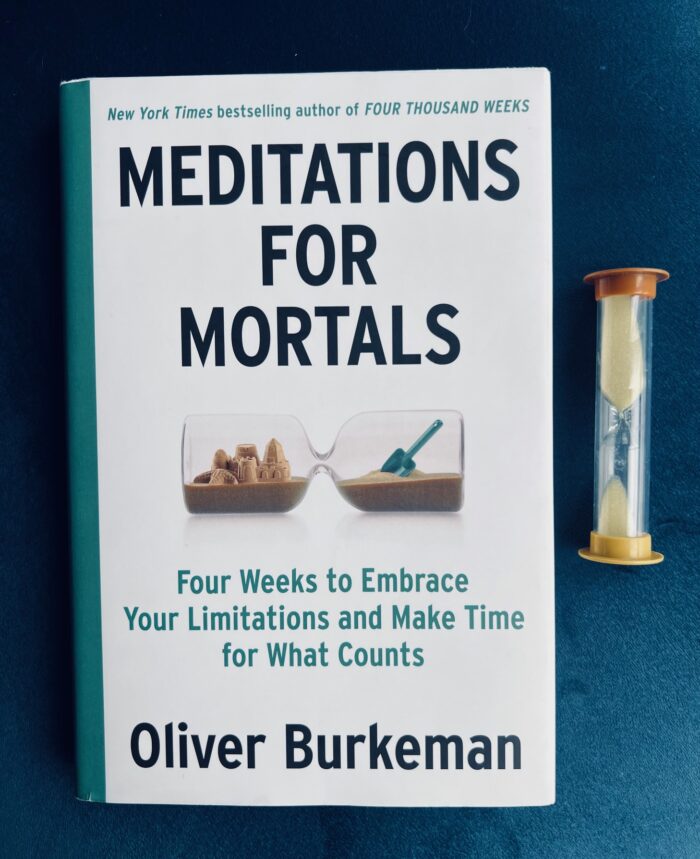
I typically like to listen to self-help books rather than read them in hard copy, so I rarely review them on this blog. I also assumed it was less interesting for my readers to read a review of a self-help book, simply because they seem so personal and specific; what one wants to improve upon in their own life varies by person. However, Meditations for Mortals by Oliver Burkeman caught my eye because the advice seemed so relatable and universal, so I went out and purchased myself a copy (a rarity in itself!). I’m breaking from tradition and reviewing it here because I think many people can gain a lot from it.
Book Summary
There is a suggested way of reading this book (which I didn’t follow) but is explained at the beginning; it’s split into 28 small sections, only a few pages long. It’s meant to be read one day at a time, over the course of four weeks. Each week focuses on a different topic, and then within those weeks, each of the seven days has a smaller focus within that. So for instance week one is titled “Being Finite”, and within that chapters with names such as “It’s Worse Than You Think” and “Let the Future be the Future”. There’s also a helpful section at the end of book similar to an index, but organized into afflictions, with the corresponding page that relates to that issue. Examples of these afflictions include; fear of the future, distraction, avoidance, need for control, irritability, and self-criticism. Keep in mind this is a short book under 200 pages, so the advice on these problems aren’t fulsome or complete, rather Burkeman offers us differing point of views and ways to re-consider these common challenges we may face.
My Thoughts
This is for people who already reach for self-help books, and are generally interested in ways to improve various aspects of their life. It’s marketed as a book to help temper that ever-increasing desire for perfection and achievement, and I think it’s safe to summarize it as basically a reminder to relax about stuff. Obviously I’m over-simplifying here, but this is one of the main takeaways I got from the book. Burkeman has a newsletter you can sign up for called The Imperfectionist, which should also be a clue as to how his advice swings. He advocates for embracing one’s limits, and through this acceptance, you can begin to shift your focus from improving everything to improving certain things. Is it just me, or do you feel yourself relax even a tiny bit more by just beginning to wrap your head around this idea?
One chapter in particular that I found really enlightening was accepting that problems were just a fact of life. He recalls a conversation between people that felt very one-sided, where one continued to complain about all the problems constantly arising in their life. The respondent then challenges them with a question – do you think at some point all your problems are going to just disappear? This is basically what life is: a never-ending journey through problems. But Burkeman reminds us that this isn’t a reason to become depressed or hopeless; instead we need to accept this, and move forward anyway.
Much of his advice stems from this very common habit we have: telling ourselves we will get to the good stuff once ‘x’ happens. For example, we promise ourselves to start taking music lessons once our day job slows down. He points out that putting off these gratifying activities or plans is futile, as there will never be the perfect time to start something. He even has a chapter specific to generosity about this; why wait until one is older and more financially secure to be generous? Start by smiling at a stranger, and build generosity into your way of being, so you can benefit from it right away. It’s not groundbreaking advice by any means, but it’s achievable and practical, the hallmark of good advice.