

Book Review: I Hope This Finds You Well by Natalie Sue
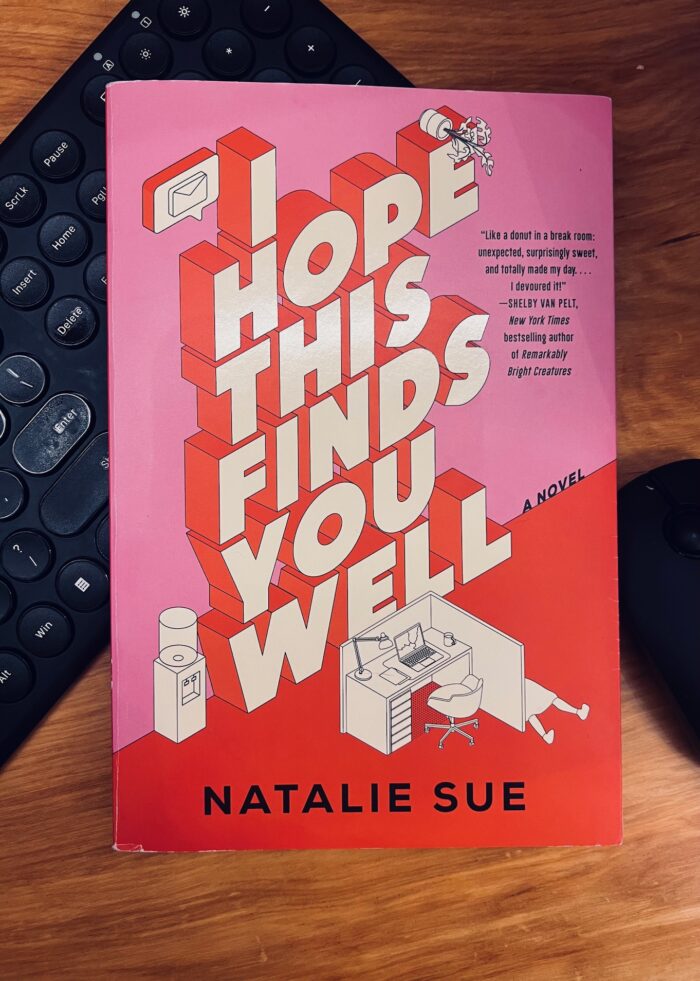
A few months ago I attended a Wordfest event where I heard local Calgary author Natalie Sue read from her debut novel, I Hope This Finds You Well. She read only a short paragraph, but I was instantly hooked; I snort laughed out loud, and loved the sarcastic and dry humour that immediately materialized. I rushed to the book table after the event to pick up a copy, and as I read it, there were so many pages I could have dog-eared as hilarious moments to revisit. Quotes below so you can see what I mean!
Plot Summary
Jolene works in a tiny cubicle, under fluorescent lights in a large firm as an administrator. She’s in her late twenties, barely scraping by on her meagre salary, hating her coworkers, and her life. Her anxiety prevents her from making many friends, and she’s so busy dodging her mother’s nosy questions that Jolene prefers to spend most of her time alone in her apartment, watching tv and drinking herself to sleep. To help ease her existential burden, she has a trick: when she writes emails, she writes a second, nasty message, and then highlights the text in white so the recipient can’t see it. But, this coping mechanism blows up in her face and she’s put on probation when the new head of HR, Cliff arrives. While she’s placed into forced sensitivity training, a strange mix-up in IT gives her the ability to read other people’s emails and instant messages in the office. Jolene keeps quiet about this new ability, and instead, uses it to gain an upper hand with her colleagues, vowing to inflict payback on their reputations while saving her job in the process. But instead of using their personal information against them, she slowly begins to learn about the issues they are all grappling with, which gives her a new perspective on her own internal struggles. Much to Jolene’s surprise, she also finds herself falling for Cliff, which is most decidedly against company policy.
My Thoughts
There’s a subtle balance between the light and dark in this novel; Jolene is dealing with some post-traumatic stress from an accident in high school, which has resulted in her struggles to connect with other people, including her own parents. And as we get to know Jolene’s coworkers through her own eyes, we also discover the challenges they face, none of them particularly shocking or unbelievable, but heavy nonetheless. It’s obvious from almost the very beginning of the book that Cliff is attracted to Jolene, but their positions at work prevent them from exploring this, and it’s clear that Jolene is in no emotional position to date anyone anyway. But still, we root for them, as it does seem like one of the very few hopeful things she has going in her life.
Despite these dire circumstances, Jolene’s humour prevents this book from falling into a depressing read. For those who have worked in an office environment, forced to spend countless hours of time with people you did not choose, this novel will definitely give you a chuckle:
“I peer over the half wall of my cubicle towards hers, which boasts a shelf lined with an assortment of dusty trinkets, inspirational quotes printed on crinkled yellow paper affixed to the wall, and a file box I know is filled with medications, tea bags, and biscuits that expired in 2012. It’s as though she anticipates being trapped here one day and not only surviving the ordeal, but thriving. I don’t mean to lock eyes with Rhonda; I blame her excessive eyeliner and the green eyeshadow that could direct traffic. ” (p. 2 of I Hope This Finds you Well by Natalie Sue)
Although I’m well past the age of Jolene, I think this novel is also a useful examination of this time of life for many in her generation: caught between your late teenage years and being an independent adult. Jolene is staring down the barrel of a boring life of office work ahead of her, realizing that her money and and prospects are limited, and not sure what to do about it. This is complicated by the high expectations of her immigrant parents, and their pressure on her to get married. Her relationship with her mother is challenging, but also a source of hilarity:
“Two new text notifications from my mom are waiting for me.
Mom: There’s a new cheat where they sneak drugs in your luggage and another guy kidnaps you! Don’t travel.
Mom: Also, Starbucks is a waste of money.” (p. 167)
I loved the balance of humour and seriousness in this book; its readable, fun, but still thoughtful. It may have slipped under your radar when it was published in 2024, so do give it a go if you’re looking for some laughs.
I read this last year and enjoyed it a lot! I’m not surprised you liked it too!
Ok yes I think I remember you posting about it! It was such a good read, I felt bad it took me so long to get to it LOL
I LOVED this book. I would reread it.
wasn’t it so great? And a Calgarian!