

Book Review: Precarious, The Lives of Migrant Workers by Marcello Di Cintio
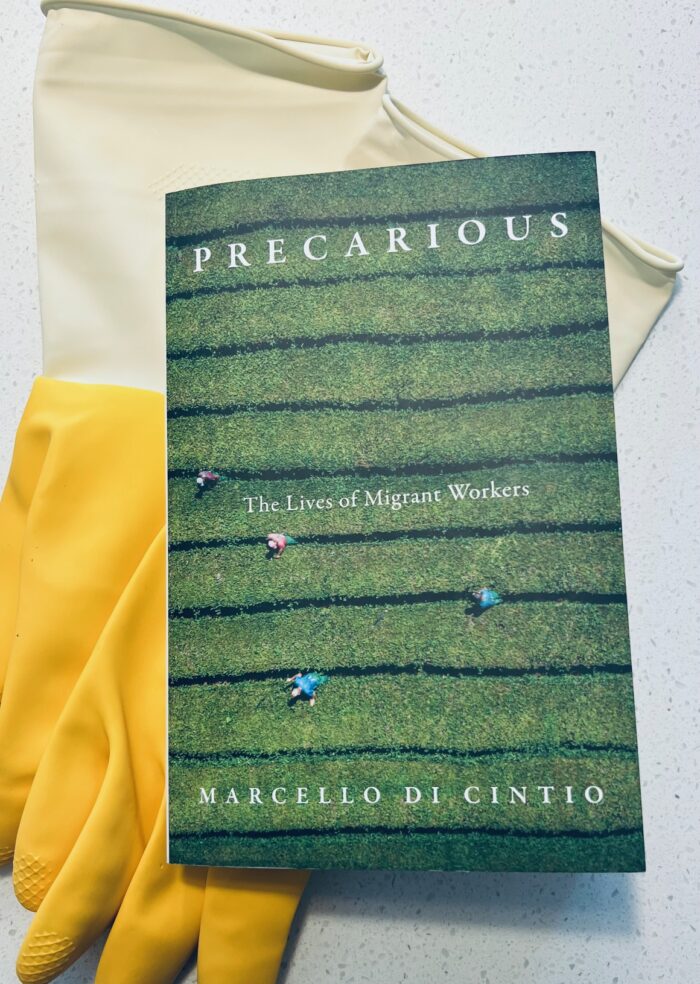
I like to focus on non-fiction in January, mainly because I’m following the ‘self-help’ trend that annually emerges after the gluttony of Christmas vacation; I’m whipping both my brain, and body back into shape. But in recent years I’ve stretched this self-help category to basically include any non-fiction, and the older I get the more I find myself fascinated with stories of other lives. This is why I picked up Precarious: The Lives of Migrant Workers by Marcello Di Cintio. I knew it wouldn’t be an easy read – who wants to be faced with the daily strife of those who are struggling to become Canadian, something I was lucky enough to be simply be born into? But I’ve read and enjoyed Di Cintio’s work in the past, (whom I know personally) plus, I love supporting local writers, so this was a challenge I was up for.
Book Summary
Di Cintio travels across Canada in search of the stories of migrant workers. He juxtaposes these very humane, often emotionally fraught tales with detailed explanations of government policy that has controlled the movements and actions of these very same people. He tells the stories of those from Mexico, the Philippines, South America and beyond, all travelling to and working in Canada in search of better pay, financial security for family members back home, physical safety, permanent residency here, or all of the above. He gives a history of migrant work in Canada and how it has changed over the years, stemming from racist policies that limited the immigrant of non-whites, to the situation that we find ourselves in today; a broken system that enables employers to abuse, threaten, and blackmail this vulnerable population. But there is also hope in these stories. Di Cintio often refers back to his own family, his grandfather coming from Italy to make a better life for his family. Similar to his last book he also includes humourous asides, and strives to show the humanity behind these often staggering statistics. He also details his efforts to meet with and learn from organizations and individuals that advocate for migrant workers, and the somewhat confusing politics they are forced to navigate. A short conclusion summarizes Di Cintio’s thoughts succinctly, followed by an extensive index that demonstrates that significant work done in researching this book.
My Thoughts
Not only is the topic a challenging subject to read about, but the text itself is quite dense with explanations of the evolving migrant policies of the Canadian government. Di Cintio points out that part of the problem with this system is the fact that it’s constantly changing, so when folks who speak English as a second language are subject to these policy changes, and vulnerable to any government slow downs, the effects can be devastating, not to mention frustrating. For that reason, I’m less likely to blame Di Cintio for the confusing rhetoric and more annoyed with my government for making this so hard, even for an English speaker like myself to navigate. Jargon is difficult for anyone to wrap their heads around, regardless of their first language.
Di Cintio’s personal opinion of this system is obvious throughout the book, but I think anyone with a heart and conscience would agree with him that the obstacles migrant workers are forced through is simply unfair. His conclusion is the most impactful and the easiest to read and understand, with very clear reasons why this system is harmful, and must change:
“Nearly all the workers I spoke to, even those like Javier and Evangeline who’d been through a unique brand of hell here, felt their trials were worth it. But this doesn’t absolve migrant labour structures of their crimes. Just because workers might emerge grateful from the gauntlet we’ve constructed, doesn’t mean the gauntlet should persist. Their Canadian wages might allow them to live
“like a king” back home, as Brett Schuyler said, but this doesn’t justify treating them like slaves here” (p. 306 of Precarious by Marcello Di Cintio).
This book unflinchingly presents an inequitable Canadian system that contradicts what we consider Canadian values of kindness and acceptance. And although it was difficult to read about, it had two positive effects on me; first, it made me SO grateful to be born into a first world country that has a stable economy in which I can make a decent living. I think most can agree this is a privilege that not many people are currently experiencing. Secondly, it reminded me of how important it is to be kind to strangers that I engage with on a daily basis, because you can never know how difficult people’s personal lives are. The idea of leaving my family for months on end to simply pay the bills is a terrible thought I couldn’t even begin to wrap my head around: this is the power of an individual’s story.

I’m curious if you were thinking about what is happening in the US right now with ICE agents, particularly in Minnesota, as you read the book. We’re not just confusing people with jargon; we’re ripping them out of homes and vehicles as they try to go to work, school, medical appointments, etc.
Your review does have me thinking. Here in the US, more liberal folks like me tend to think of Canada as a happy place, but having contact with you and Karissa reminds me that Canada is not a utopia. I have absolutely learned that over many years thanks to you two. One thing that stands out to me is how you and Karissa both, at different times, have been stay at home moms, or stay at home moms who work a few hours per week and are able to live in houses. There is no way you could do that in the US, especially when I think of Karissa’s husband, Peter, who is a school teacher.
Your comment is actually quite similar to FF’s above, in that compared to other countries, Canada is much better (or at least seems better), and no doubt, what’s happening in the U.S. certainly makes Canada look like a utopia! With this book, Di Cintio often speaks about the fact that we Canadians tend to be a bit smug about how much better we are than other countries, because many people see us a safer and happier place. However, he is pointing out the fact that we have problems here as well, and we can’t ignore the fact that we have broken systems here too.
Canada’s universal healthcare system is a big part in what gives people freedom to work less, in my opinion. However, our taxes are higher, so we have less disposable income (or at least it appears to me) than Americans do. So, we can choose to work less, and spend less money, but still have relative comfort knowing that if we get sick, we don’t go bankrupt. This is of course a huge generalization, but despite all our issues with healthcare (i.e. people dying in emergency rooms because our system is overrun, and not enough drs) I am grateful knowing that we have public healthcare.
Interesting, since I’ve just been reading a (fiction) book that was praising the Canadian refugee system as being so much more humane than our own. I guess we’re all critical of our own systems – the grass always look greener elsewhere!
That is interesting, and very true. One thing this book doesn’t do (at all) is compare our immigration systems to others, so the Canadian system could be way better! That wasn’t the topic of this book unfortunately haha
Such an important topic. I’m curious how much of the book is history, as I think that would be important, especially if one was coming to the topic without having read about it before or being aware in general, but I imagine that could also be a little overwhelming. I’m reminded of how Ibram X. Kendi wasn’t planning to write Stamped from the Beginning, he was just trying to write a short essay about racism in the U.S. and eleventy-billion pages later, SftB was finished. Do you think there’s truth to the idea that one naturally reads more non-fiction as one ages? (i.e. not only in January hee hee)
There’s not a TON of history, just enough to give you a good sense of how things have developed over the past few decades, but of course, this is a huge topic. And I definitely agree that one reads more non-fiction as they age, I find myself doing it more and more, I almost can’t help myself LOL
A few years ago, I read a few novels of “immigrant literature” that stick with me: E.g., The Tortilla Curtain (Mexican immigrants); The Sympathizer (Vietnamese immigrants); and The Boat People (Sri Lankan immigrants.) Novels help humanize news stories. I will check out Mr. Di Cintio’s book, as a non-fiction alternative. Thanks, Anne.
Thanks Janet – I think you’ll find this one interesting, a good non-fiction take on what some immigrants are experiencing. And I owe you an email!