

Book Review: The Ex-Boyfriend’s Favorite Recipe Funeral Committee by Saki Kawashiro
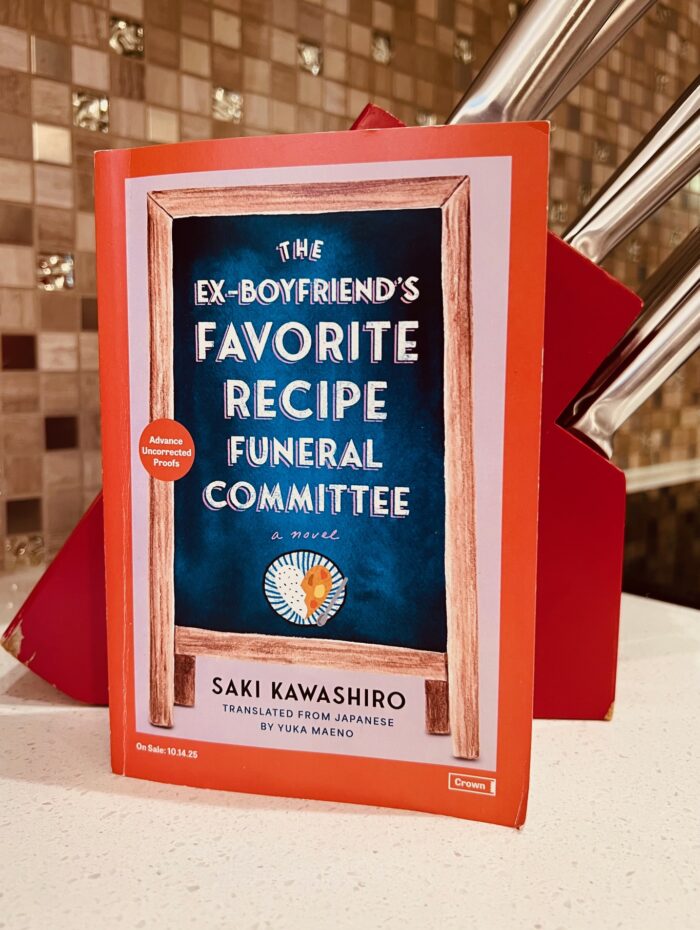
My exploration into Japanese Cozy Fiction continues with The Ex-Boyfriend’s Favorite Recipe Funeral Committee by Saki Kawashiro, translated into English by Yuka Maeno. I’m not finding this genre all that satisfying to be completely honest, but I also don’t mind an easy read every once in a while, which this definitely offers. If food is your love language, you’ll want to check out this book, because it highlights the emotional connection one feels when sampling certain dishes, and even better, it includes a few recipes for those looking for an authentic reading experience with a delicious twist.
Plot Summary
Momoko has just gotten unexpectedly dumped by her boyfriend of four years. In a fit of tears and despair, she finds herself wandering the streets, and ends up in a tiny cafe that’s serving curry, a favourite of her ex’s that she used to make for him. There are two men at the cafe; one is a strikingly handsome man named Iori, who seems to be the cafe manager, and a monk named Hozumi who has a penchant for ice cream floats, and is the cafe’s only customer. Momoko is still in shock and pours her heart out to these men, who calmly try to reason with her. After tasting the cafe’s disgusting curry, Momoko insists on making them her own version, to see if the curry really was as good as her ex used to claim it was, or if this was just another one of his lies. To her relief, both Hozumi and Iori agree that the recipe is delicious, which leads Momoko to realize that cooking this dish for others is helping her move past the pain that she finds herself in. Iori offers her a job at the restaurant, and Momoko accepts, looking for a fresh start. Together, the three of them come up with a plan to host ‘recipe funerals’ that invite people to come and eat a recipe from their previous relationships. They market this as a way for customers to find peace, but they are also hoping it attracts new business, as the cafe is in desperate need of cash flow. Each chapter details the story of another customer and their heartbreak and ends with the recipe itself. Through each new committee meeting, the three friends begin to deepen on their own relationships with one another, and reflect on the difficult relationships from their past.
My Thoughts
There are many things you should not expect to find in this book; including realism, character depth, and challenging ideas. Instead, you will experience feelings of contentment, romantic idealism, and hunger pangs. One of my greatest frustrations was the lack of backstory or explanation when it came to Momoko’s life. Her inner turmoil comes across as shallow while she continues to whine about her breakup, and her moments of insight seem random and forced. It was hard to concentrate on where I should be placing my focus – the strangers that come out of the woodwork to deal with their own internal conflicts, or the rag-tag group that run the cafe? Both groups are underdeveloped, as the short book can in no way explore any situation with any kind of detail.
It’s not a terrible book, but I’m quickly realizing I really don’t like this genre, evident in my last review of a similar title here. There’s not much to analyze here, other than the fact that I’m not the right reader for it.
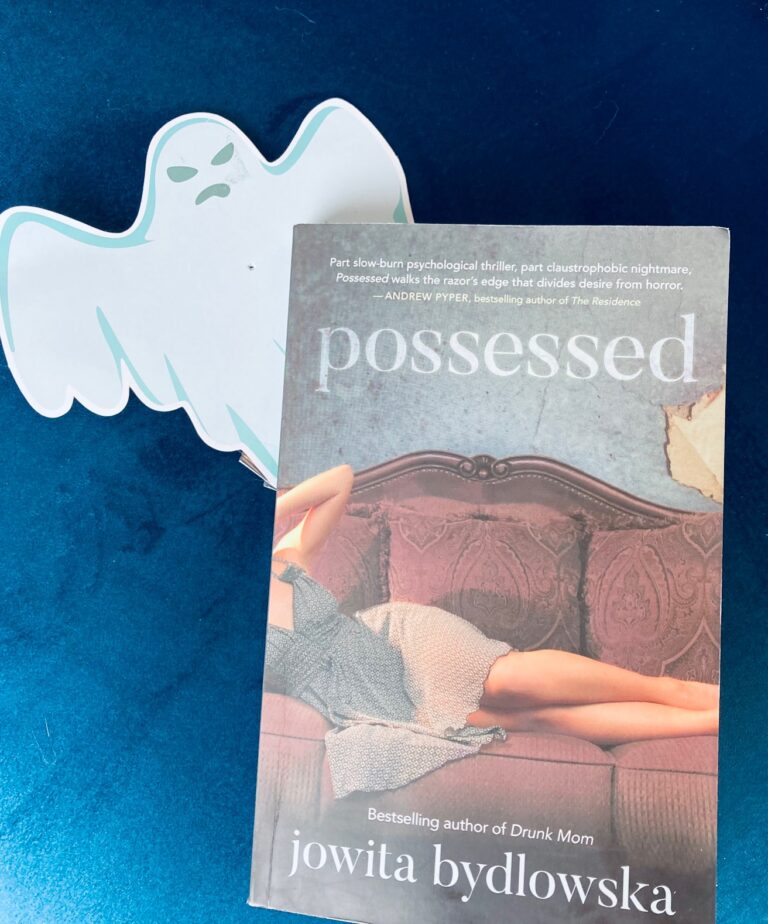
“There are many things you should not expect to find in this book; including realism, character depth, and challenging ideas.”
Hahaha, noted! I don’t think this genre would be to my taste either, but that’s the great thing about books – there’s something for everyone!
So true! It’s a good read, just not for me…
I’ve noticed a lot of translated Japanese fiction tends to be short, like, undoubtedly novella length. Therefore, some times the characters seem underdeveloped, and in many cases, they are hella unrealistic. Sounds like it’s time to move on! I’ve heard that some Japanese fiction that is less fluffy is really good, though. I have Breast and Eggs by Mieko Kawakami on my TBR
Japanese Fiction itself is of course, a very worthwhile, varied genre. Japanese Cozy Fiction is very different – it’s meant to be short on purpose, to keep the stakes low, which I totally get. I think my problem is that I keep comparing cozy fiction itself (mainly mysteries) to this new genre of Japanese Cozy Fiction, which fall short in so many ways. But! I’m hopeful that because it seems to be a fairly new and emerging genre, some writers can make push it to better heights :)
I keep wondering if there’s just something in the translation or cultural norms/ expectations that I’m missing with these cozy Asian books.
I am wondering the same thing haha
I haven’t loved the cozy Japanese fiction I’ve read either, though I haven’t read that much either. I think in general I’m not looking for this kind of feeling in my reading but I can see where it has its audience.
Exactly! I’m just not the intended audience, and that’s ok
Okay, fair enough, the genre isn’t for you. But if you think for a moment about the idea that you are classing mysteries, in which people get stabbed and strangled and kidnapped and beaten, as cosy reading…that you MIIIIGHT not have been the right target audience to begin with? 🤣
LOL! true true