
Book Review: The Correspondent by Virginia Evans
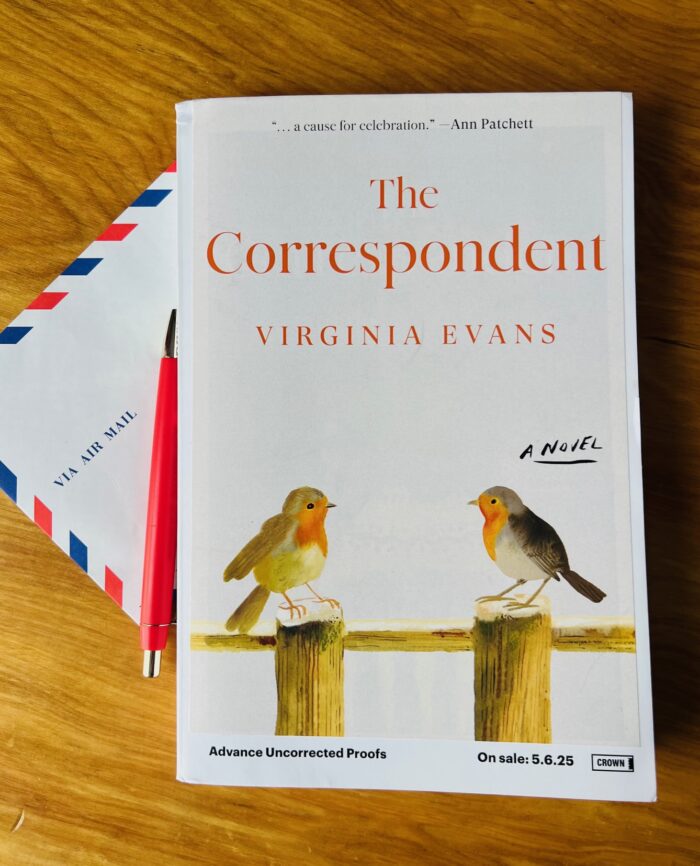
It doesn’t feel like I’m saying much when I state this is the best book of the year, and it’s only January. So instead, I’ll say The Correspondent by Virginia Evans is one of my favourite books that I’ve read in a really, really long time. I had it on my shelf since the publisher sent it to me last year when it was published, and then a literary agent urged me to read it, which is always a good sign, as they read ALOT. Then it started to pop up on ‘best of 2025’, which really clinched it for me – what was I waiting for? I dove in, savoured it, and was disappointed when it ended just shy of 300 pages. For someone who loves ‘finishing’ books like I do, this is really saying something!
Plot Summary
This is an epistolary novel, meaning it’s told entirely in letters; a format I don’t come across often, but typically enjoy. Most letters are written by the protagonist Sybil Van Antwerp, a women in her early seventies who lives alone, but has always made sense of her world through writing. We uncover the history of her life as well as her current situation through her letters to others as well as their responses back to her. She’s lived a life of regular ups and downs including a family tragedy. She’s now a grandmother, but struggles with her relationship with her kids. She has some men in her life that are clearly looking for more, but she doesn’t seem all that interested in progressing things. Her eyesight is failing, and it’s a secret she isn’t telling many people, but it does emerge in her writing to a select few. There is one set of letters that she does write but does never sends, and it isn’t revealed until later who these are meant for, although it’s not really a secret either, it’s quite obvious for those who are paying attention. It’s in this unsent correspondence that we learn how she is truly feeling and the struggles she doesn’t want to bother others with. We are introduced to Sybil when her life is quite small, preferring to stick close to home and her beloved garden, but as the book progresses the outside world gradually pushes its way in, and she’s forced to confront the more complicated aspects of her life that she was hoping to avoid or ignore.
My Thoughts
It’s impressive how much a story and its plot can progress through correspondence alone, and Evans bends the rules a bit by including occasional emails. At one point, Sybil receives a gift from a family member that prompts her to have her DNA analyzed to determine her familial ancestry, and the emails with her results, as well as the emails between her and a customer service representative open up a whole new aspect to the plot that added significant colour to both the story, and Sybil’s life. And despite the relatively quiet life Sybil leads, she has kept up correspondence with an astounding number of people, so even though she never travels (self-imposed), there are many people who want her to come see them, and these opportunities blossom along with the story, so there’s much to hope for and look forward to. This sense of possibility frightens Sybil, but it keeps the book entertaining and lively.
Sybil’s voice and personality are most definitely the highlight of this story. She is cranky, she likes to speak her mind, and yet her dedication to manners makes her a person that is impossible to dislike. The letters in which she sends to those that she’s unhappy with were my favourite, and those people’s irritated responses (hidden under a polite veneer) were also a great form of entertainment. Some of these letters are quite lighthearted like the drama in her local garden club, but there are other letters that I found so emotionally devastating I came close to tears. The tragedy at the center of Sybil’s life is something she clearly struggles with and has many regrets around, but what becomes clear to the reader by the end of the book is where the true tragedy in her life really lies; in the letters she never sent, the and the words she never spoke aloud.
Lovers of the written word and physical books (hello, it’s me!) will also appreciate this story for Sybil’s steadfast dedication to letter writing, and the permanence of a words written on a page. People grudgingly accept her insistence in writing letters as opposed to emails, but she often has to explain this passion of hers at different points in the story for those new to her quirk:
“If all this amounts to you as nothing more than drivel, then you might also consider a simpler value of the written letter, which is, namely, that reaching out in correspondence is really one of the original forms of civility in the world, the preservation of which has to be of some value we cannot yet see. The WRITTEN WORD, Mr. Watts. The written word in black and white. It is letters. It is books. It is law. It’s all the same.” (p. 46-47 of The Correspondent by Virginia Evans, ARC edition).
What’s most incredible about this book is the fact that it’s a debut novel. This will be a difficult act to follow, simply because it’s so good.
I love a good epistolary novel! How funny that you enjoyed her cranky emails the most. That makes me smile.
I love a cranky person when I’m not on the receiving end of it! haha
This sounds great! Why haven’t I heard of it before – it has zillions of Goodreads ratings, so it’s clearly popular! I’d love to return to a world of letters rather than emails – they’ve never had the same feel, and you can; tie them up in bundles and keep them in a drawer. I’ll look out for this one – thanks!
I hope you can find it over there in the UK FF – it’s really a wonderful book
I’ve been hearing about this all over the place! I’m glad to hear that you liked it too – I really need to add it to my list.
It’s SUCH a good read Karissa. Can’t say that enough
I love epistolary novels. One of my favorites is Dear Everybody by Michael Kimball. It’s about a guy who dies by suicide but first writes letters to literally everyone he knows. He even writes to God, the tooth fairy, Santa, and himself as a boy. I think this book sounds interesting, so I plan to add it to my TBR. I’ll let my mom know, too. I think she’s been struggling lately with finding a good book.
Dear Everybody sounds quite sad! But this is a wonderful novel, yes I highly recommend it. It’s really picked up steam I think, its been a word of mouth success, which is always a good sign.